Ever wondered why some foreigners like to live in Indonesia? Well, maybe my list of TOP 10 best of living in Indonesia will explain. Here it goes.
1. Best coffee and tea in the world.
Cultivation of coffee trees in Indonesia started on Java in 17th century when Dutch first brought coffee to Batavia (city changed its name to Jakarta in 1942) and started export of the second oldest commercially produced coffee in the world – Java coffee. Ever since Indonesia has been one of the major exporters of coffee and today it is the world's fourth largest exporter. Majority of production is a Robusta coffee, but production and export of high quality Arabica coffee is slowly increasing. If you happen to be in Indonesia you can enjoy freshly roasted high quality coffee from Java, Sumatra, Aceh and other areas of Indonesia.

A cup of cappuccino in Jakarta can be as good as in Rome or even better, thanks to the optimum freshness of coffee – it is premium quality up to one week after roasting. My favourite choice of locally produced coffee is
Merdeka Coffee, Excelso is also great. I leave
Starbucks to amateur coffee drinkers. I'll just mention one thing that I've found fairly ridiculous about local cafés and especially Cup&Cino café at Plaza Semangi. They don't have Indonesian coffee in their offer, so it is foreign franchise selling imported coffee in country which is 4th largest exporter of coffee in the word and a producer of high quality coffee! I consider this to be an example of awful lack of support for Indonesia and when I and my friends found out we decided to boycott the place.
What about tea? In Poland everyone knows Java tea and it is one of the most popular beverages (if not the most popular) in Poland. There's nothing better than enjoying a cup of original Java tea in the early morning mountain mist at the place from which this tea originates i.e. tea fields around Puncak. Incredible experience.
2. Hot weather all year long.
Yup, sun shines here all year long with only short periods of rain during rainy season. When I decided to emigrate I had to make a choice between Canada and Indonesia. Although Canada is a great place to live, I decided to move to Indonesia. I simply hate winter and perspective of not having to experience it each year was just too tempting. Since I also like when it rains this place is just perfect for me. There are number of advantages of living in a tropical country among which most interesting is: not having to buy new winter clothes each year; enjoying sun anytime during the year; no winter depression and ability to wear simple cloths such as t-shirt all year long. Indonesia is a fantastic place to live for everyone who likes hot weather.
3. AMAZING tourist attractions.
Indonesia has some of the most famous diving spots and beaches in the world. The most famous is certainly Bunaken National Park, considered as one of the top 10 dive spots in the world. However, with 25 percent of world's coral reefs located in Indonesia, there are plenty of opportunities for divers. Beside Bunaken, other known diving areas are located around Lombok Island, channel between Nusa Penida and Nusa Ceningan, Sanighe Island (North Sulawesi), Biaro Island, Bangka Island etc.
 Siau
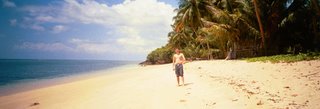 Beach at Sangihe Island
Bali has some of the world's most famous beaches such as Kuta or Jimbaran. I've personally found
Siau (North Sulawesi) to be most impressive as it was my favourite spot among all my travels around Indonesia, yet unfortunately it is poorly developed and not ready for a mainstream tourism.
Indonesia has also quite a few UNESCO World Heritage sites, such as:
- Komodo National Park,
- Ujung Kulon National Park,
- Borobudur Temple compound,
- Prambanan Temple compound,
- Sangiran Early Man Site,
- Lorentz National Park,
- Tropical Rainforest Heritage of Sumatra.
 Borobudur
Overall Indonesia has so many tourist attractions, from tropical beaches and diving spots, to rare rainforest flora and fauna, volcanoes, hot springs and simply whatever you could imagine.

I'll jut conclude that tourists pay thousands of dollars to get here for short holidays. If you happen to live in Indonesia all these world's famous tourist destinations are available only few hours of flight away. This also means you can get fancy holidays for ridiculously low amount of money and with no special preparations. Moreover, if you have KITAS (stay permit) you can get discounts in hotels and pay lower entrance fee at some tourists spots such as Borobudur or Bunaken.
4. Indonesian people.
The national motto of Indonesia "Bhinneka tunggal ika" (Unity in diversity) reflects the union of a various different cultures. The significant variety of cultures transfers also to the daily life and simply makes it more interesting. We can enjoy various arts from different parts of Indonesia, variety of food (more about this in next point), variety of local traditions, various religion ceremonies which overall is extremely interesting and definitely enriching our experience. Moreover, in general Indonesian people are so friendly and life enjoying that I think we could learn a lot from their positive nature. It's hard to stay positive even when everything around seems negative (financial crisis, wars, riots in the news) and somehow locals can deal with this perfectly well. Beside, the specific culture that is so much different makes our lives here interesting every day, there's always something new to surprise us.

Note: If you're Caucasian you'll have to get used to hearing "Hello mister!" and if you happen to visit place lest frequently visited by foreigners you may observe crowds of people surrounding you and asking various questions. The best advice for such situation is "smile and wave". All this can be very surprising experience and it simply reflects interest of local people in foreigners. Nothing to worry about, just enjoy the unusual situation.
5. Great variety of food and fresh fruits.
Ever seen Durian, the infamous smelly king fruit loved by Indonesians?

Well, you can actually eat it here for most of the year. Beside if you live in Indonesia you can enjoy lots of other unique fruits that you won't be able to find in supermarkets in Europe such as fresh Mango, Rambutan, Bali fruit, Snake fruit etc. You can enjoy all these tropical fruits daily and fresh. Beside this the variety of food available in Jakarta is also interesting. Padang food (spicy), Balinese food, Manadonese food, various of soto and satay from all over Indonesia or even such a strange delicates like snake satay (can be found in Kota). Additionally, lots of unique Chinese food and very cheap seafood.

Well, there is one minus, that is a lack of immunity to local diseases which can quickly result in a very bad stomach ache. However, the good news is that after two years or so you'll get immune to nearly everything, including typhoid and God or "kaki lima" chef knows what strange food related diseases.
6. Exciting and challenging life.
Since Indonesia is so big and different, it is actually a big challenge to live here in a very different culture. However, this can just make our lives more interesting. Actually, there are so many events here daily that you'll hardly get bored. If you're news junkie you'll here about number of disaster each month, from crashing planes, sinking ferries up to mudflows or floods, earthquakes and volcanoes, you name there's everything here. It's quite sad actually. It also frightens foreign tourists a lot – especially bombings – but for those of us who live here slowly get accustom to such extreme life and simply watch these extreme events as they unfold and discuss it with friends. Are we crazy to still stay here?
Well, foreign news agencies like to exaggerate a lot and the truth is that Indonesia is lot safer than most think and actually often even safer than your own country. Just to let you know USA just released new travel warning for Indonesia and let me quote it:
Due to the possibility of terrorist attacks directed against American or other Western citizens and interests, the Department of State urges American citizens to evaluate carefully the risks of travel to Indonesia. The October 1, 2005, terrorist attacks in Bali in which suicide bombers killed 20 people and injured more three than 100 are a reminder that terrorists remain active in Indonesia. The possibility of future attacks in Bali, Jakarta, or other areas of Indonesia cannot be ruled out.
They are certainly right, but base on plain statistics lot less people died as a result of terrorism in Indonesia than in USA, so it really is not that bad as you might think. Life is unpredictable and we can't be completely safe anywhere. Actually, I find myself feeling lot safer at night on the streets of Jakarta than in my small city in Poland. More than five years here and I had not a single incident of someone attacking me or trying to start a fight, while I had such experiences quite often in Poland.
7. Efficient government service.
Now, it'll get bit controversial as opinion on this subject is highly diversified.
Few months here and you probably already know the term KKN (Korupsi-Kolusi-Nepostisme), which obviously means Corruption-Collusion-Nepotism. Indonesians often use it to describe all corruption related experience and it is definitely significant issue here and has a various forms. You're probably surprised with my introduction as what corruption has to do with efficiency of government services? Well, I see several kinds of corruption and surprisingly, one small type of corruption activities of local government officials I actually consider as beneficial. Why? Well, if I lose some important document in Poland it could take a month to get a replacement, while In Indonesia if you are in rush you can simply pay bit more to the officer and get your documents done the very same day, as I've heard. If for some reasons you have a problem with documents i.e. you can't find Hungarian/Russian/Mandarin/Hindu/Hokien/Irish translator of some document that you need for certain govt procedure, you'll only have to pay bit more and government official will suddenly read not only the previously mentioned languages, but also Dutch or even Farsi, Klingon and any language you can imagine – as I've heard. So, some are of something called here KKN is actually often helpful. In our countries red tape can be very annoying and time consuming while here we you still have other options and don't have to look for certified Klingon translator.
FYI I'm very surprised to read information about suppose lack of efficiency of local government in the process of establishing companies here in Indonesia as compared to neighbour countries. If you want to know how ridiculous it is just take a look at this
document. According to some Law Firms Interview (World Bank 2005), number of days for setting up a business (PT. company) in Indonesia is about 151 days! In reality, it is very different from what was described in the report. For comparison The University of Indonesia’s Institute of Economic and Social Research (LPEM) shows that it takes only 80 days (57 working days) and all Indonesians know it can take even shorter, less than 14 days. If you are really in hurry can even have everything done in one week – with some additional budget and help of professional notary service. So, I personally think some government offices are functioning here fairly well and definitely not as bad as described in some official reports.
Of course there are number of bad examples of corruption in Indonesia such as the one that results in loss of lives, state funds or unfair judgement. However, not everything considered as corruption is all bad and some kick-back just helps to go quicker through all the red tape. Unfortunately, with limited funds a service of a government official can be very slow, thus clearly there are two sides to this story and my point of view is obviously not objective.
8. Dynamic business environment.
Indonesia's Economic growth accelerated to 5.1% in 2004 and reached 5.6% in 2005. The most interesting is that markets here are still relatively unexplored and full of opportunities. It's definitely not easy to do business here due to number of factors, but if you happen to succeed the potential revenue is substantial. Considering the big population, consumer attitude, richness of natural resources I believe Indonesia has a huge potential and it is definitely good place to invest.
Furthermore, Indonesia has number of highly skilled people in various areas, such as IT, art, mining etc. My focus is mainly in IT and I already noticed how highly skilled Indonesian programmers can be. It's interesting to know that Indonesia has one of the largest Java (programming language) user communities in the world and many local Java programmers able to work on most difficult Java projects - I believe the popularity of this language has lot to do with its name. Indonesia is actually a very good place for outsourcing and I myself managed to outsource several IT project to Indonesia with a successful result. I hope more will follow and one day Indonesia will be as popular destination for outsourcing as India. Unfortunately, Internet connection is still extremely expensive here, but I believe it will eventually get cheaper.
9. Domestic servants.
Ability to hire
domestic servants is one of the significant advantages of living in Indonesia. An average monthly salary of a maid who can take care of your house of apartment can be around 100$ a month - if they work at apartment usually they take care of few apartments to make more profit. Driver's monthly salary can be in range of US$150 plus overtime. Clearly it does not cost much to hire domestic servants in Indonesia. Their work make our lives lot easier and saves us lots of precious time.
Certainly, presence of domestic servants in Indonesia is caused by poverty and overall it is quite sad. Yet, I personally think that considering high unemployment in Indonesia, giving job to people is always a good thing, even if it is job of gardener, house keeper or security guard. Just make sure you appreciate their work and help them in some ways i.e. by supporting education of their children.
10. Low cost of living.
Indonesia can be very cheap place to live and if you have foreign source of income you'll definitely enjoy staying here. The gasoline is extremely cheap if compared to Europe (only around US$0.5 per litre). Food at restaurants is also lot cheaper than in neighbour countries and extremely cheap if compared to Europe or USA. Property is also not too expensive (yet) and if you're a smoker you can buy very cheap cigarettes.
Clearly, Indonesia is a very interesting place to live and now you probably understand better why some foreigners decide to live in Indonesia. Simply speaking it is a beautiful, dynamic country with fantastic people. Definitely a great place to live, invest and enjoy your life.


 I took the above photos on Sunday around 4AM, just after a heavy rain. The first one shows area of Cempaka Mas (view of South-West skyline), the second photo shows area of Sunter (view of city's West skyline). It is an extremely odd view as during regular night Jakarta shines with tens of thousands of lights. Last night most lights were still on but today it is just dark space with only a few lone candlelights. A truly gloomy view of Jakarta.


